
Kelso's $510M Continuation Vehicle and What It Means for HVAC and Mechanical Sellers

Earlier this month, Peterson Partners announced it had raised $510 million for a continuation vehicle. The capital will support the continued growth of Kelso Industries, the mechanical, electrical, and plumbing (MEP) services platform Peterson Partners launched in 2021. NorthSands Capital committed more than $450 million as the sole lead investor, and Peterson's own Fund X rolled its position and put in additional money. In roughly five years, Kelso has grown to more than 4,000 employees operating in over 40 states.
That's an unusually rapid build in the MEP market, and instead of fully exiting Kelso, Peterson brought on a new investment partner, recapitalized the business, and held onto ownership.
If you sold your company into a platform like this – or you're considering an offer that includes rollover equity – that should get your attention because it can change when that "second bite" comes and what it looks like. Let's walk through what a continuation vehicle is, why they’ve become more common, and what one could mean for the equity you roll.
What Is a Continuation Vehicle?
A private equity firm (called the general partner or GP) raises money from investors (called limited partners or LPs). That money goes into a fund with a set lifespan, often around 10 years. The fund buys companies, grows them, and eventually sells them to return cash to the LPs.
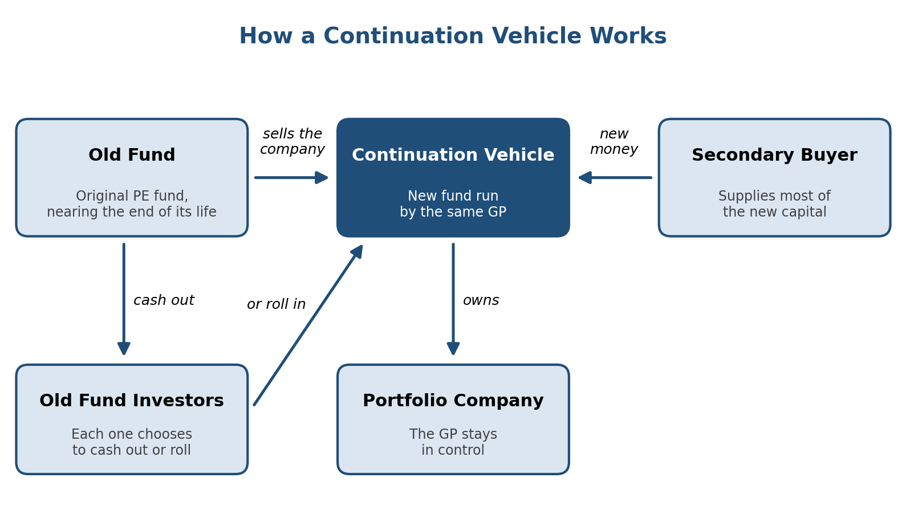
A continuation vehicle (CV) is a new fund the GP sets up to buy one or more companies out of its own older fund, which usually looks something like this:
● The old fund sells the company to the new vehicle (same company, management, and GP; the ownership just moves from one fund to another).
● The old fund's investors choose to take cash now or roll their stake into the new vehicle.
● New secondary buyers provide the capital. In Kelso's case, NorthSands injected more than $450 million of the $510 million raised. Their capital pays out the LPs who want to leave and funds future growth.
● The GP stays in charge and may establish new management-fee and carried-interest (its share of the profits) economics, while the business gets fresh capital to keep making acquisitions and investing in growth.
Why Are Continuation Vehicles Everywhere Now?
Kelso isn't an outlier. According to GCM Grosvenor, continuation vehicles hit a record $106 billion in 2025, up about 51% from the year before. A whopping 83% of the top 100 global buyout sponsors have used one, and CVs now account for roughly 15% of sponsor-backed exit value, which is up from 8% in 2021. What’s driving that growth?
● The exit backlog: Funds have to return cash to their investors eventually, and traditional exits have been slow. McKinsey estimates about 16,000 buyout-backed companies worldwide have been held for more than four years, the highest share of total inventory on record, and average holding periods have stretched to 6.6 years. A CV gets LPs their money without a full sale.
● Holding onto high-performers. When a GP believes a company still has several years of growth ahead, selling it means leaving value on the table. A CV lets them keep riding it.
● Price considerations. If outside bids don't meet the GP's view of what a company is worth, a CV is an alternative to accepting a lower number. An auction process is the way platforms determine the true value of the business. Today, an auction process may produce lower than the GP’s desired valuation because many platforms that were formed when debt was cheap and multiples peaked. A CV can give a platform more runway to achieve a more attractive valuation in the future.
● A deeper buyer pool. Ten years ago, there weren't many investors who did this kind of deal. Now there are dedicated secondary funds like NorthSands to write these checks.
Why Might Mechanical Roll-Ups Be Good Candidates?
Several things could make HVAC and mechanical platforms good candidates for continuation vehicles.
● Timing: Many of the platforms in our space were formed between 2019 and 2022. With a typical five-to-seven-year hold, a lot of them are reaching exit age right now.
● Size: As platforms grow, the pool of buyers narrows, especially at large enterprise valuations. This narrows the pool of buyers to a handful of public mechanical companies and large PE firms. Fewer bidders mean less competition, which could result in a less attractive valuation from a limited buyer pool.
● Runway: The trades are still highly fragmented, so there's plenty of room left to buy and build. Financial sponsors accounted for about 50% of HVAC services deals so far in 2026, and most of that activity was add-on acquisitions to existing platforms.
● Tailwinds: Data center construction, electrification, aging building stock, and the EPA's phase-down of HFC refrigerants can strengthen the case for holding the position versus exiting.
What Should Owners Consider about Rollover Equity?
Most private equity buyers will ask you to reinvest at least some proceeds as rollover equity in the platform. That presents the opportunity for future upside and potentially a second payday when the platform sells. However, a continuation vehicle can change it in ways many sellers don't anticipate.
● Your second-bite timeline can move, so don’t plan on a specific date.
● The CV changes the valuation, but that doesn’t automatically tell you what happens to your rollover. That depends on your rights and the deal structure.
● You may not get the same election rights as the fund’s LPs. Have your attorney and advisor go over the documents before you sign, not after a CV is announced.
● There could be a reset. The new investor comes in with its own terms, and the GP usually resets its fees and carried interest. Know where you fall in the distribution process.
● Tax deferral isn’t automatic. It depends on how the rollover is structured, and moving your equity or taking cash along the way can change the tax treatment. Get your advisor involved early on.
What to Ask before Rolling Equity
Before rolling your equity into a platform, make sure you ask these questions:
● How long has the fund been around?
● Is this the first continuation vehicle for this sponsor?
● If the sponsor’s done a CV before, how were minority holders treated?
● What happens to rollover equity in different scenarios?
● Is there a put right, a liquidity window, or any minimum-return protection?
● How is our equity valued between exits, and how often?
Continuation Vehicles Aren't Inherently Bad
It would be easy to read all of this as a warning against continuation vehicles, but it isn't.
A CV can reflect real sponsor conviction. When a GP puts its current fund's money back into a company, it's a bet that there’s still more value to be created. Fresh capital can speed up acquisitions and growth and, in the end, increase the value of your stake. The biggest risk in rolling equity is not understanding your rights if this happens.
Rollover Equity Is a Second Investment Decision
When you sell to private equity, most of the attention goes to the headline price. But the equity you roll isn't just a deal term. It's actually a second investment, and you need to pay as much attention to it as you did to the first. Structure it with the possibility of a continuation vehicle in mind, because in today's market that's a realistic scenario.
At IEI Advisors, we help owners evaluate the full economics of an offer and work with their legal and tax advisors to understand the trade-offs. If you're weighing an offer that includes rollover equity, or you already hold equity in a platform and want to better understand your position, contact us. We're happy to walk you through it.
Sources:


